Safe URL Checker
The Safe URL Checker verifies whether a website URL or link is flagged as suspicious, malicious, or unsafe by Google ...
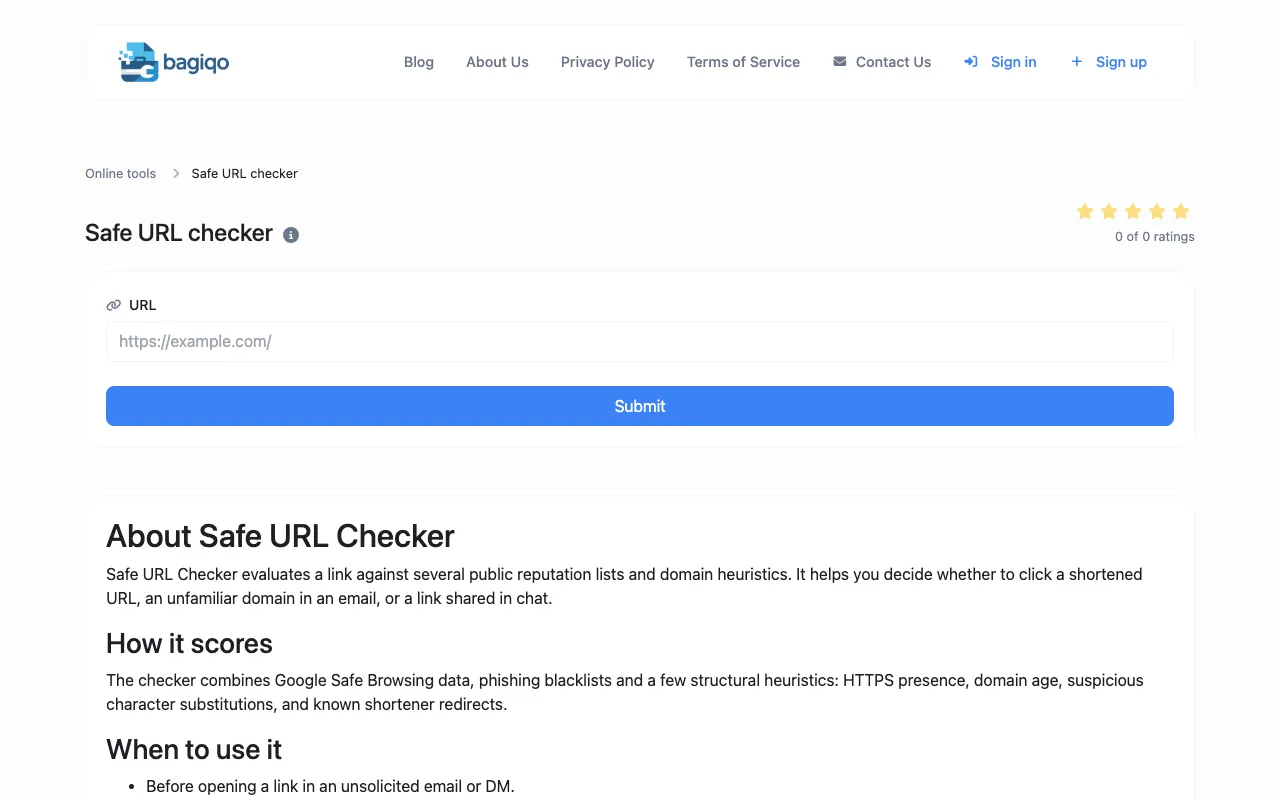
What Safe URL Checker does
The Safe URL Checker evaluates a link against public reputation lists and domain heuristics to help users decide whether to click shortened URLs, unfamiliar domains in email, or links shared in chat. Results indicate whether a link is flagged as suspicious, malicious, or unsafe by Google Safe Browsing data, phishing blacklists, and structural checks. Users receive a clear safety assessment that informs decisions before opening links from unsolicited messages or sharing them publicly. The tool provides a practical safety filter for everyday online interactions without requiring technical expertise.
How to use the Bagiqo Safe URL Checker
- 1
Paste the full URL you want to check into the input field on the Safe URL Checker page
- 2
Click the Submit button to initiate the safety evaluation against public reputation lists
- 3
Review the safety result displayed, which indicates if the link is flagged as safe or unsafe
- 4
Use the outcome to decide whether to open the link, share it further, or investigate the destination domain manually
Best for
Security-conscious users, content moderators, email administrators, and web professionals who need to verify link safety before clicking or sharing potentially dangerous URLs.
Limitations
- No blacklist is exhaustive, so a clean result reduces risk but does not guarantee a page is safe to visit
- Results are based on automated checks and may not catch every emerging threat
- The tool provides estimates rather than definitive safety guarantees for any given URL
Safe URL Checker FAQ
- How accurate is the Safe URL Checker at detecting malicious links?
- The checker combines Google Safe Browsing data, phishing blacklists, and structural heuristics to assess link safety, but no blacklist is exhaustive, so a clean result reduces risk without guaranteeing absolute safety.
- Can I check shortened URLs like bit.ly or t.co links?
- Yes, the tool is designed to help users decide whether to click shortened URLs by evaluating them against public reputation lists and domain heuristics including known shortener redirects.
- What should I do if the checker says a link is unsafe?
- Do not open the link, avoid sharing it further, and consider investigating the destination domain manually through other means before proceeding.
- Does the Safe URL Checker work for all types of websites?
- It evaluates links against several public reputation lists and domain heuristics, but results are estimates and may not cover every emerging threat or obscure domain.
Similar tools
Based on shared tags