Miscellaneous Calculators3 options compared

Dimensional Weight Calculator

Calculates the volumetric weight of packages based on their dimensions, helping determine shipping costs by postal services. Enter length, width, height, and package type to estimate the dimensional weight. Useful for businesses and individuals needing accurate shipment cost estimates. Ideal for e-commerce, logistics, and anyone involved in international or domestic shipping. Helps ensure proper...

Editors’ Top PickBased on community votes
Other OptionsRanked by votes
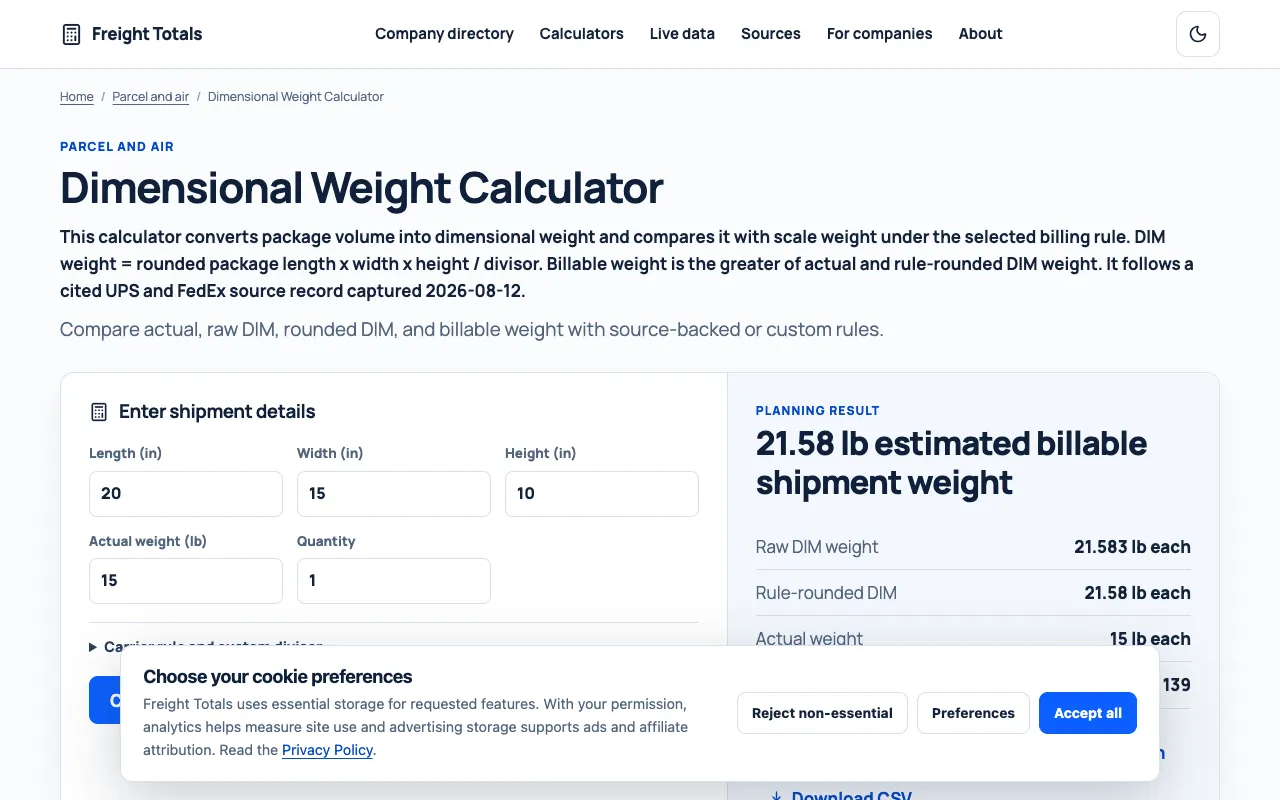
  1. Screenshot of FreightTotals
    02
    FreightTotals
    freighttotals.com

    Compare actual, dimensional, and billable weight from package dimensions, scale weight, carrier rule, and a UPS, FedE...
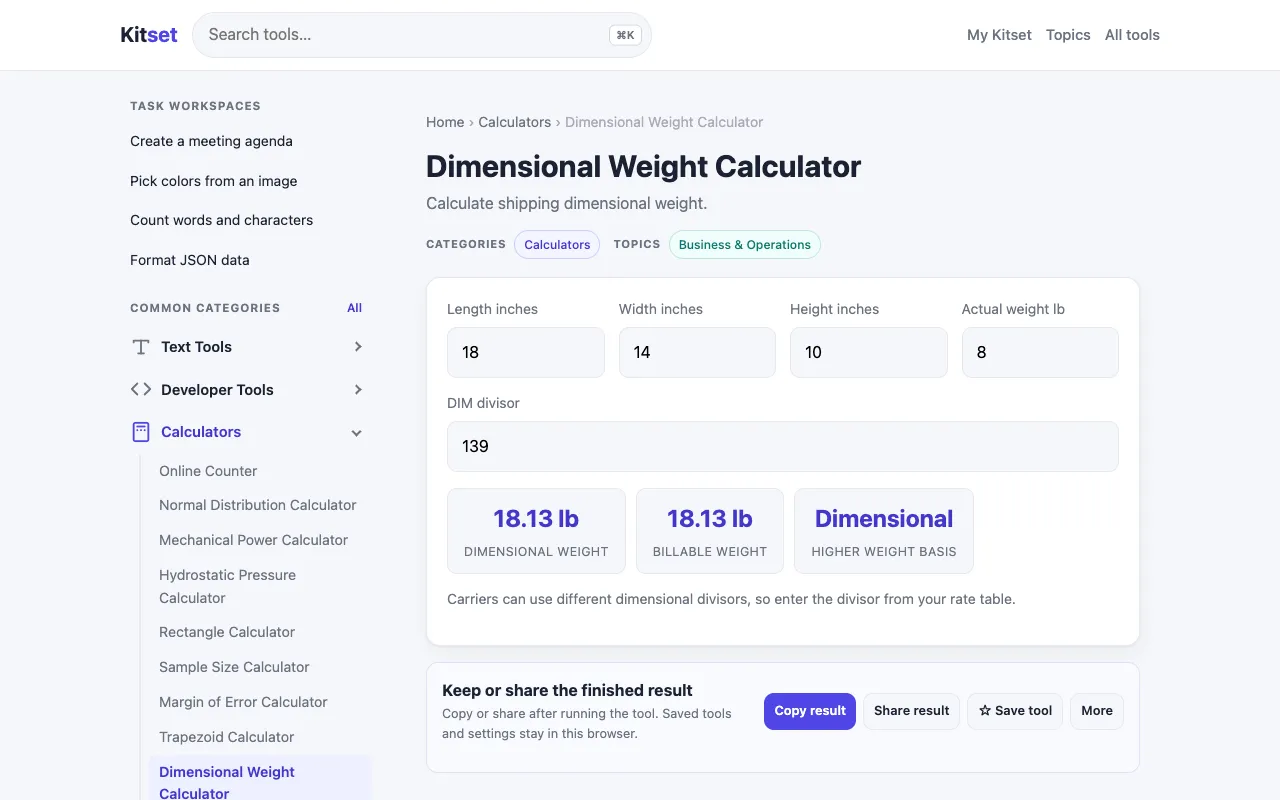
  2. Screenshot of Kitset
    03
    Kitset
    kitset.app

    Calculate dimensional weight and billable weight from package dimensions, actual weight and DIM divisor.

Side by side

Dimensional Weight Calculator options compared

ToolBest forStrengthsLimitations
Omni Calculator
omnicalculator.com
Quick estimates with carrier info
  • Explains dimensional weight concept
  • Includes FedEx, UPS, USPS notes
  • Supports multiple unit systems
  • Fewer advanced comparison features
  • No custom divisor input field visible
FreightTotals
freighttotals.com
Side-by-side weight comparison
  • Compares actual, dimensional, and billable weight
  • Lets you set custom divisor and carrier rule
  • Shows rule-rounded and calculated load arrangement
  • Interface is more technical
  • Fewer unit options likely
Kitset
kitset.app
Quick dimensional weight from dimensions
  • Calculates dimensional and billable weight from dimensions, actual weight, and DIM divisor
  • Minimalist design from Kitset app
  • No live page excerpt available
  • Community votes and features very limited

Buyer's guide

How to choose a dimensional weight calculator

When picking a dimensional weight calculator, the key factors are the DIM divisor you need to match your carrier's pricing and whether you want to see how the calculated billable weight compares to your package's actual weight. If you just need a quick estimate and want to understand how major carriers like FedEx, UPS, or USPS apply dimensional weight, a tool that includes carrier-specific notes and unit flexibility is ideal. If you are shipping regularly and need to ensure you are using the correct divisor and rounding rules for your specific carrier, a calculator that lets you input a custom divisor and shows both actual and billable weight side-by-side will save you from underpaying or overpaying shipping costs.

Questions

Dimensional Weight Calculator FAQ

How do I calculate dimensional weight for my package?
Measure the package's length, width, and height, then multiply those three numbers to get the cubic size. Divide the cubic size by the DIM divisor used by your carrier (e.g., 139 for UPS Ground in the US, 166 for FedEx Ground) to get the dimensional weight. Compare that number to the package's actual weight on a scale; the higher of the two is typically the billable weight used by the carrier.
What is a DIM divisor and why does it matter?
A DIM divisor is a number carriers use to convert a package's volume into an equivalent weight. It matters because if you use the wrong divisor, your calculated dimensional weight — and thus your shipping cost — will be incorrect. Different carriers and service levels use different divisors, so always check your carrier's current rate sheet.
Why does dimensional weight exist?
Dimensional weight exists because large, lightweight packages take up significant space on a truck or plane even though they don't weigh much. Carriers use dimensional weight to ensure they are compensated for the space a package occupies, rather than just its actual weight.
Can I use the same DIM divisor for all my shipments?
Not necessarily. Carriers often have different divisors for domestic versus international shipments, or for different service levels (e.g., ground vs. air). Always verify the divisor that applies to your specific shipment type and destination before calculating.
What happens if my actual weight is higher than the dimensional weight?
If the actual weight on the scale is higher than the calculated dimensional weight, the carrier will usually bill you based on the actual weight, since that reflects the true mass of the package. The higher of the two weights is the standard billing rule for most postal and freight services.
Keep Exploring

Related tools in Miscellaneous Calculators

View all →