Classical Mechanics2 options compared

Ideal Gas Law Calculator

Calculates pressure, volume, and temperature of a gas based on the ideal gas law formula PV=nRT. Users input known values to solve for unknowns in equations related to gas behavior under varying conditions. Ideal for students, educators, scientists, and professionals working with gases in chemistry, physics, engineering, or environmental science who need quick, accurate calculations without manual...

Editors’ Top PickBased on community votes
Other OptionsRanked by votes
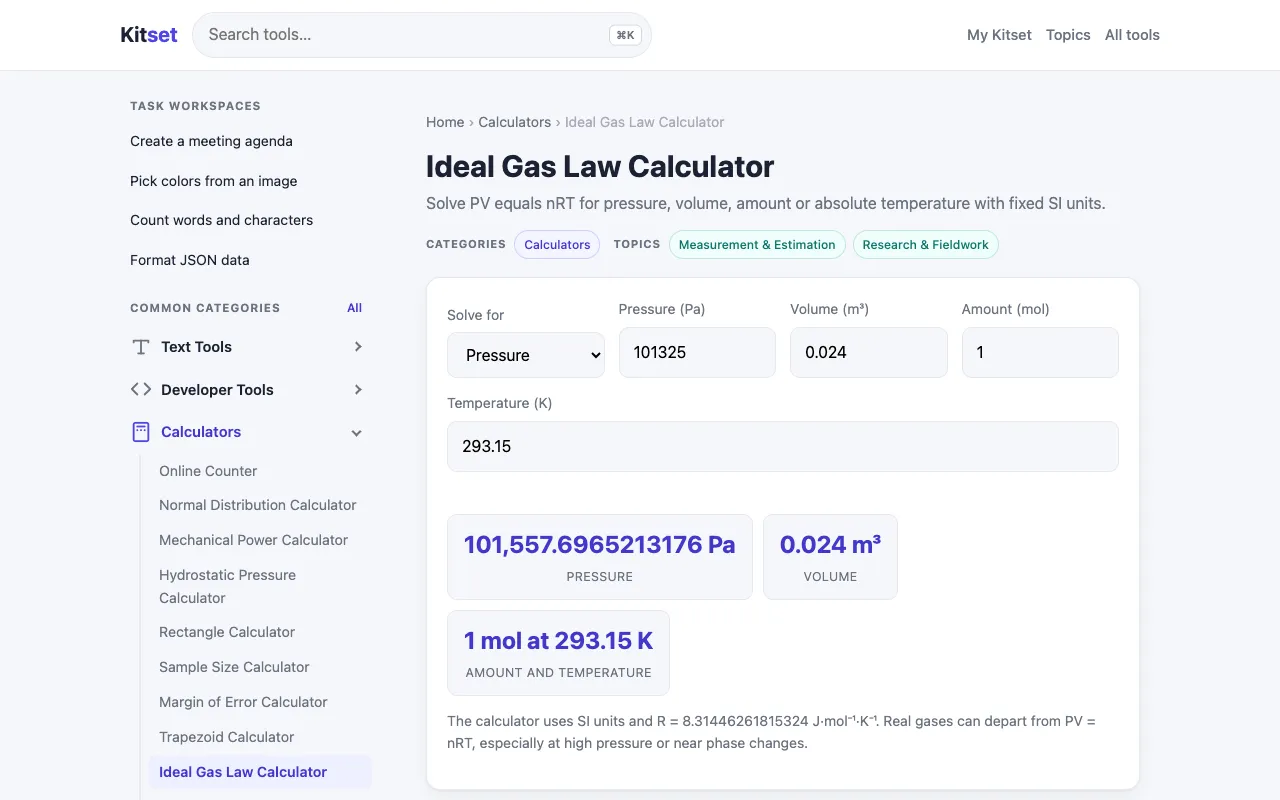
  1. Screenshot of Kitset
    02
    Kitset
    kitset.app

    Calculate pressure, volume, moles or Kelvin temperature from the other three ideal-gas variables in SI units.

Side by side

Ideal Gas Law Calculator options compared

ToolBest forStrengthsLimitations
Omni Calculator
omnicalculator.com
Students and quick checks
  • User-friendly interface
  • Related calculators linked
  • Ads on the page
  • Fewer unit options
Kitset
kitset.app
SI unit precision
  • SI unit focus
  • Minimal interface
  • No community votes
  • Page could not be fetched

Buyer's guide

How to choose a ideal gas law calculator

When picking an ideal gas law calculator, decide whether you need quick, visual help or strict unit control. If you are a student or need to explore related topics, Omni Calculator's linked resources and familiar layout make it easier to use. If you are working in a lab or classroom that requires SI units exclusively and want a clean, ad-free experience, Kitset's tool is the better fit.

Questions

Ideal Gas Law Calculator FAQ

What is the ideal gas law formula?
The ideal gas law formula is PV = nRT, where P is pressure, V is volume, n is the number of moles, R is the gas constant, and T is temperature in Kelvin.
Can I use this calculator with units other than SI?
Omni Calculator supports various input units and automatically converts them, while Kitset's tool is designed specifically for SI units, so check which tool matches your preferred unit system.
Is the ideal gas law accurate for real gases?
The ideal gas law assumes no intermolecular forces and that gas particles have no volume, so it works best at high temperature and low pressure; real gases deviate from this behavior under other conditions.
Do I need to convert temperature to Kelvin before using the calculator?
Yes, the ideal gas law requires temperature in Kelvin; if your temperature is in Celsius or Fahrenheit, convert it first before entering the values.
What does the gas constant R represent?
The gas constant R relates the energy scale to the temperature scale and its value depends on the units used for pressure, volume, and amount of substance, commonly 8.314 J/(mol·K) in SI units.
Keep Exploring

Related tools in Classical Mechanics

View all →