18 tools
This free Rate of Return Calculator estimates annualized return from an initial value, final value, and investment length. It also supports interim periodic deposits or withdrawals, which makes it close to average-return tools that account for cash flows. The calculator is browser-based with no mandatory paid plan.
Calculates future values based on regular investments and compound interest rates. This tool allows users to input various financial variables, including initial principal amounts, contribution frequencies, and differing annual interest rates. It accurately demonstrates how different compounding periods—such as annually, semi-annually, or monthly—impact the growth of money over time. By visualizing these complex interactions, the calculator helps illustrate the power of reinvesting earnings back into an investment to generate further returns. Individuals interested in long-term financial planning and retirement savings can use this resource. Students learning about personal finance also find it useful for understanding core investment concepts. Anyone needing to compare potential return rates or model various saving scenarios benefits from its clear, comparative outputs.
Investors use a mutual fund calculator to project the future value of their holdings based on initial principal, recurring contributions, and expected annual returns. It simplifies complex financial projections by allowing users to visualize how capital grows over time within a specific investment structure. By adjusting growth rates and investment durations, individuals can better align their portfolio choices with long-term retirement or savings objectives. Beyond simple growth estimates, the calculator provides a detailed breakdown of how various charges and fees impact the final outcome. It accounts for expense ratios and sales loads to determine the actual internal rate of return. This transparency helps users identify the real cost of ownership and compare the performance potential of different funds before committing capital to a particular strategy.
Determining the time required to recover an initial investment is a fundamental step in financial planning and capital budgeting. This calculator streamlines that process by analyzing both steady and irregular cash flows to identify when a project will reach its break-even point. Business owners and investors can use these insights to compare different opportunities and assess the level of risk associated with various capital expenditures. The interface provides comprehensive metrics including the standard payback period and the discounted payback period, which accounts for the time value of money. By inputting initial costs and projected annual returns, users gain a clearer understanding of their average return on investment. This detailed breakdown helps in making informed decisions about resource allocation and long-term financial sustainability.
Achieving long-term financial goals requires a clear understanding of how consistent contributions and interest rates interact over time. The Savings Calculator provides a detailed projection of wealth accumulation by factoring in initial balances, regular monthly deposits, and expected annual returns. Users can adjust variables to see how different savings strategies impact their final balance, making it easier to plan for major life events or retirement. Individuals looking to optimize their personal finances find value in the ability to visualize the power of compound interest. By illustrating the difference between total contributions and interest earned, the tool highlights the benefits of starting early and maintaining a steady investment schedule. This data-driven approach helps savers set realistic targets and understand the timeframe needed to reach specific financial milestones.
Calculates simple interest using the standard I = P × r × t formula, allowing users to determine the total return or cost of capital over time. Users input the principal amount, annual rate, and time period, and the tool instantly computes both the accumulated interest earned and the final balance. Additionally, it provides a detailed monthly breakdown of the growth and offers a comparative view showing how simple versus compound interest rates affect overall investment returns. Investors, loan borrowers, or financial students use this calculator to model potential financial outcomes accurately. It helps individuals understand the basic mechanics of lending and saving by visualizing the difference between linear (simple) and exponential (compound) rate growth.
Calculates various parameters of a bond, including price and accrued interest for bonds not traded at the coupon date. Users input bond details like face value, coupon rate, years to maturity, and yield to maturity to receive calculations. Investors, particularly those managing fixed-income portfolios or analyzing potential investments, find it useful. It aids in making informed decisions about bond purchases or sales by providing quick, accurate financial metrics.
Calculates your rate of return on investment (ROI) with this versatile online financial tool. It determines both the total ROI percentage and the annualized ROI for any investment scenario. Users can input precise start and end dates to calculate returns based on actual time elapsed, or they can simply enter the length of the investment period when exact dates are not available. The calculator processes the inputs to provide a clear understanding of how much an investment has grown over its lifespan. Investors, financial planners, and students studying personal finance benefit from this tool. It provides an objective way to compare potential investments or evaluate past performance against specific benchmarks.
Calculates the future value of investments by modeling compound interest growth over time. This comprehensive tool allows users to project potential investment totals based on various financial inputs, including an initial lump sum amount, regular periodic contributions, and a specified annual rate of return. It provides a clear visualization of how both consistent deposits and compounding interest work together to increase capital over extended periods. Investors and personal finance enthusiasts use this calculator to model long-term savings goals and retirement planning scenarios. By adjusting variables such as contribution frequency and expected growth rates, users can estimate the power of disciplined investing and determine what level of saving is necessary to meet specific financial targets. It helps users understand the mathematical impact of time on wealth accumulation.
Calculates the present value of future money using established financial principles, specifically addressing the concept of the time value of money. Users can determine what a sum of money received in the future is worth today by inputting variables such as the amount, the discount rate, and the number of periods. The tool handles both single lump sums and recurring payments known as annuities, allowing for detailed comparisons across multiple potential discount rates to refine financial planning models. Investment professionals, financial students, and long-term planners utilize this calculator to evaluate potential returns and assess current asset worth. By accurately converting future cash flows into present-day equivalents, users can make more informed decisions regarding investments, retirement savings, or major capital expenditures.
Calculates various financial interest rates using established formulas, allowing users to solve for unknown variables in investment growth scenarios. The tool supports finding the implied rate from known present value, future value, and time period. Furthermore, it employs sophisticated mathematical methods, such as Newton-Raphson iteration, to determine the precise interest rate needed to grow any initial sum of money to a specified target amount over set periods. Financial planners, investors, and mortgage applicants use this resource to model potential returns and assess loan viability. Users can quickly adjust variables to compare different investment strategies or understand the true cost of borrowing across various timeframes.
Calculates annual dividend income based on share price, number of shares held, payment frequency, and tax implications. Users input details like stock symbol, current price per share, number of dividends paid annually, and applicable tax rates to receive quarterly dividend amounts and total annual yield. Ideal for investors looking to estimate their potential dividend income and understand the financial impact of taxes on their investment returns.
Calculates compound interest on investments to determine potential future balances and earnings over time. Users can input details regarding an initial investment amount, expected annual percentage rate, compounding frequency, and optional periodic contributions. The tool generates a detailed schedule showing how both the principal and accumulated interest grow across various periods, providing a clear projection of total growth. Individuals planning for retirement, saving for major purchases, or evaluating investment strategies utilize this resource. It helps users visualize the powerful effect of consistent investing and compound growth on their financial goals. Anyone needing to estimate the long-term viability of savings plans or understand the impact of different contribution schedules finds this calculator useful.
Calculates the total interest, end balance, and growth chart for a Certificate of Deposit with an option to factor in income tax. Enter principal amount, term length, and annual interest rate; select tax treatment to view comprehensive financial outcomes. Suitable for individuals planning long-term savings or retirement who need to understand the potential growth and taxes associated with CDs. Helps users make informed decisions about their investments by providing clear visualizations of account growth over time.
Calculates the Internal Rate of Return (IRR) for various investment scenarios using user-provided cash flow data. The tool accepts inputs ranging from fixed recurring amounts to irregular annual streams, allowing users to model different financial outcomes. By analyzing a series of initial and subsequent cash flows, it determines the discount rate at which the net present value equals zero, providing a key metric for evaluating profitability across time. Finance professionals, business students, and investors utilize this calculator when assessing the viability of potential projects or investments. It helps determine whether an investment’s expected returns justify its initial outlay by quantifying the annualized effective compounded return rate.
Calculates the potential future value of an investment based on user-provided financial parameters. This tool allows users to input an initial principal amount, a fixed annual interest rate, the intended duration of the investment in years, and any regular additional monthly contributions. By combining these variables, the calculator models compound growth over time, providing a comprehensive estimate of the total accumulated value without needing complex financial formulas. Individuals planning for long-term financial goals or seeking to understand market potential use this resource. It assists people who want to project their savings trajectory or evaluate different saving strategies before committing capital.
Calculates fundamental financial metrics essential for personal budgeting and long-term planning. This comprehensive online tool allows users to determine future value (FV), present value (PV), periodic payment (PMT), compounding periods (N), and interest rates (I/Y). Users input various financial variables—such as an initial investment, expected growth rate, or desired payoff amount—and the calculator provides accurate estimates for these complex time-value of money calculations. Individuals managing savings goals, planning for retirement, or analyzing loan repayments can utilize this resource. Students learning finance concepts, new homeowners calculating mortgage affordability, and investors projecting portfolio growth all benefit from its detailed functionality.
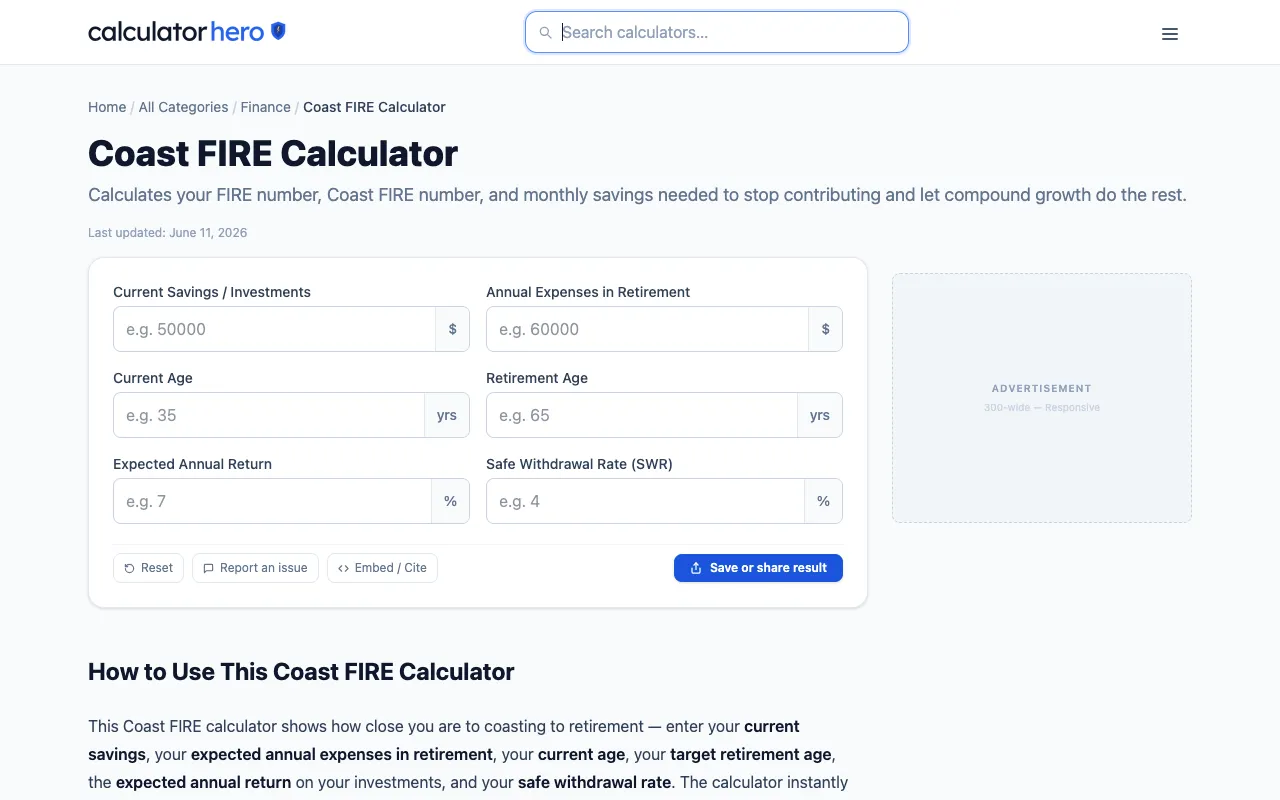
Calculates savings required to coast to FIRE (Financial Independence, Retire Early) at retirement age. Determines how much needs to be saved now to allow investments to grow to retirement goals without additional contributions. Useful for individuals pursuing FIRE strategies who want to reduce savings intensity in later career years. Helps plan whether current savings can reach retirement goals through investment growth alone, informing long-term financial strategy.