29 tools
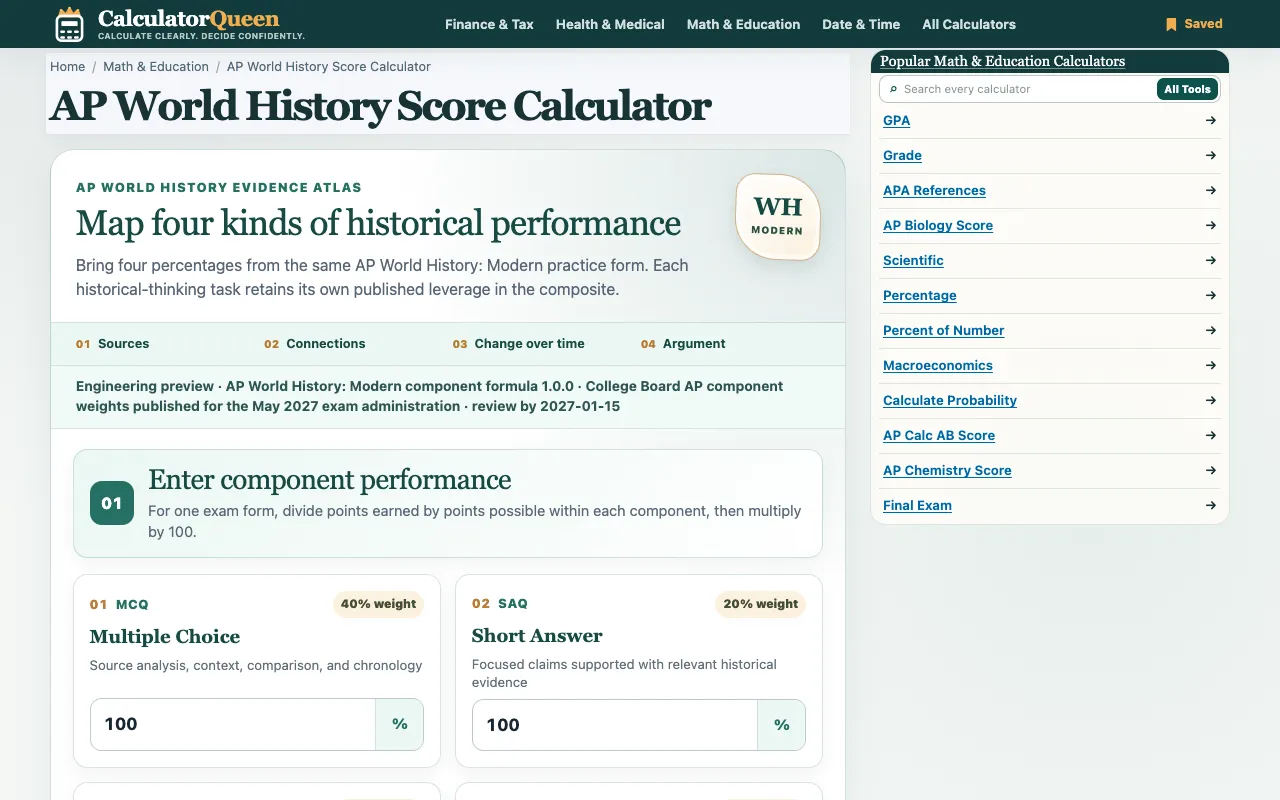
Estimate your AP World History: Modern exam score by entering raw scores for multiple-choice questions, short-answer questions, document-based questions, and long-essay questions. The calculator applies the official weighting percentages (40% MCQ, 20% SAQ, 25% DBQ, 15% LEQ) to compute a composite score on a 0–100 scale based on actual exam structure. The tool displays every step of the calculation and explicitly labels the result as an unofficial estimate. Seeing the visible weighting factors helps you understand how each section type contributes to your overall performance. No signup is required, and the calculator supports realistic input ranges for accurate practice assessment and score prediction.
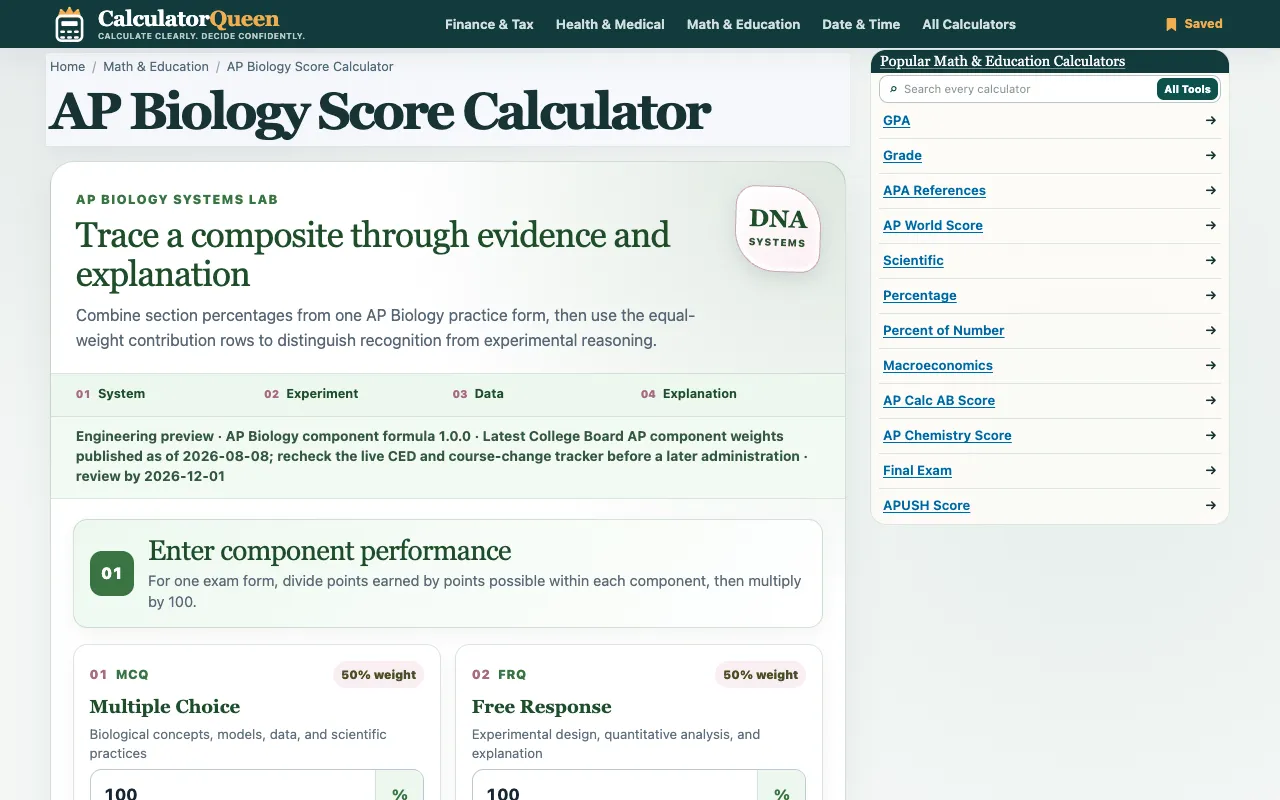
Estimate your AP Biology exam score by entering raw scores from the multiple-choice section and your free-response question performance. The calculator applies the official weighting to convert your component scores into a composite on a 0–100 scale, showing every calculation step. The tool clearly labels the estimated score range as unofficial and does not guarantee any particular exam result. It supports realistic input bounds across all question types and presents the calculation transparently so you can understand how each component affects your overall performance. No signup is required, and the results help with practice assessment and score prediction.
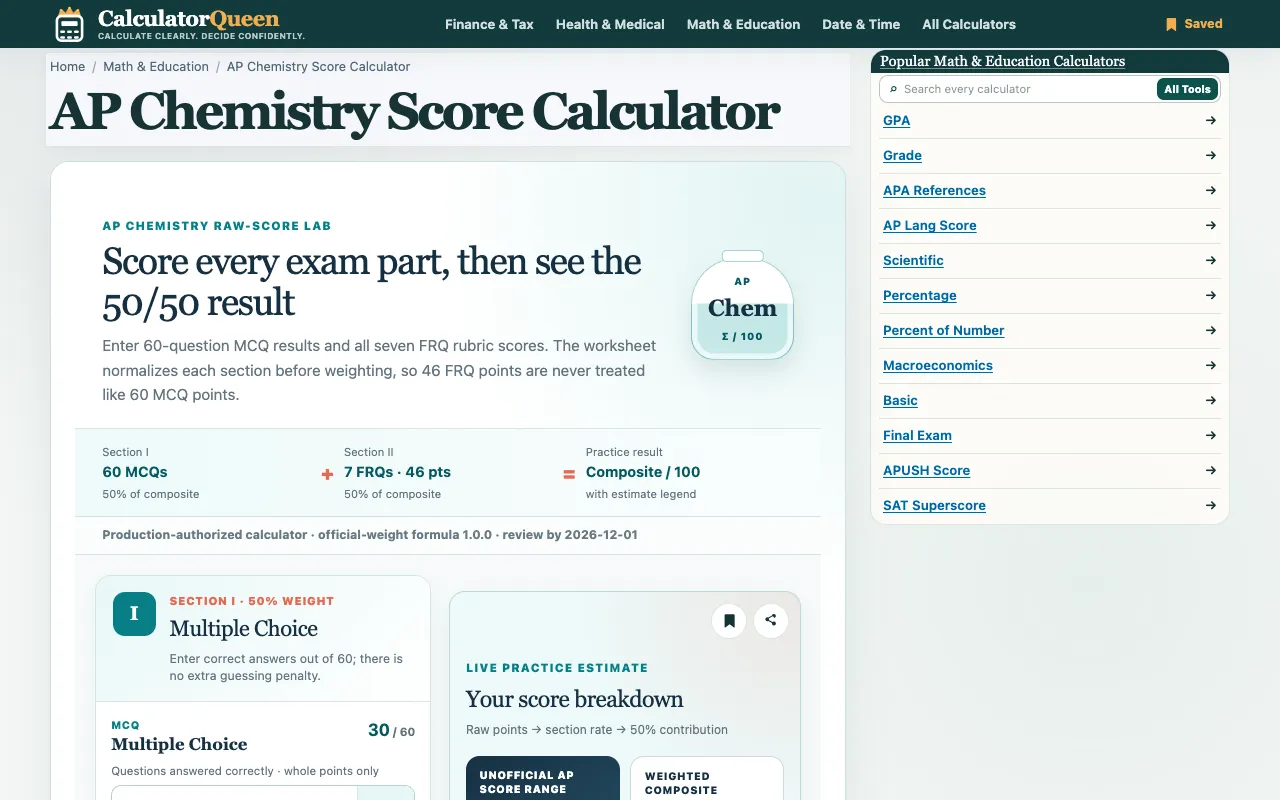
Estimate your AP Chemistry exam score by entering raw scores from the multiple-choice section and your seven free-response questions. The calculator applies an equal 50/50 weighting to combine MCQ and FRQ performance into a composite score on a 0–100 scale. The tool reports an estimated 1–5 score range based on your composite and explicitly labels this estimate as unofficial without claiming any guarantee of your actual exam result. The visible weighting and calculation methodology help you understand how the two major sections contribute equally to your performance. No signup is required for practice assessment and score prediction.
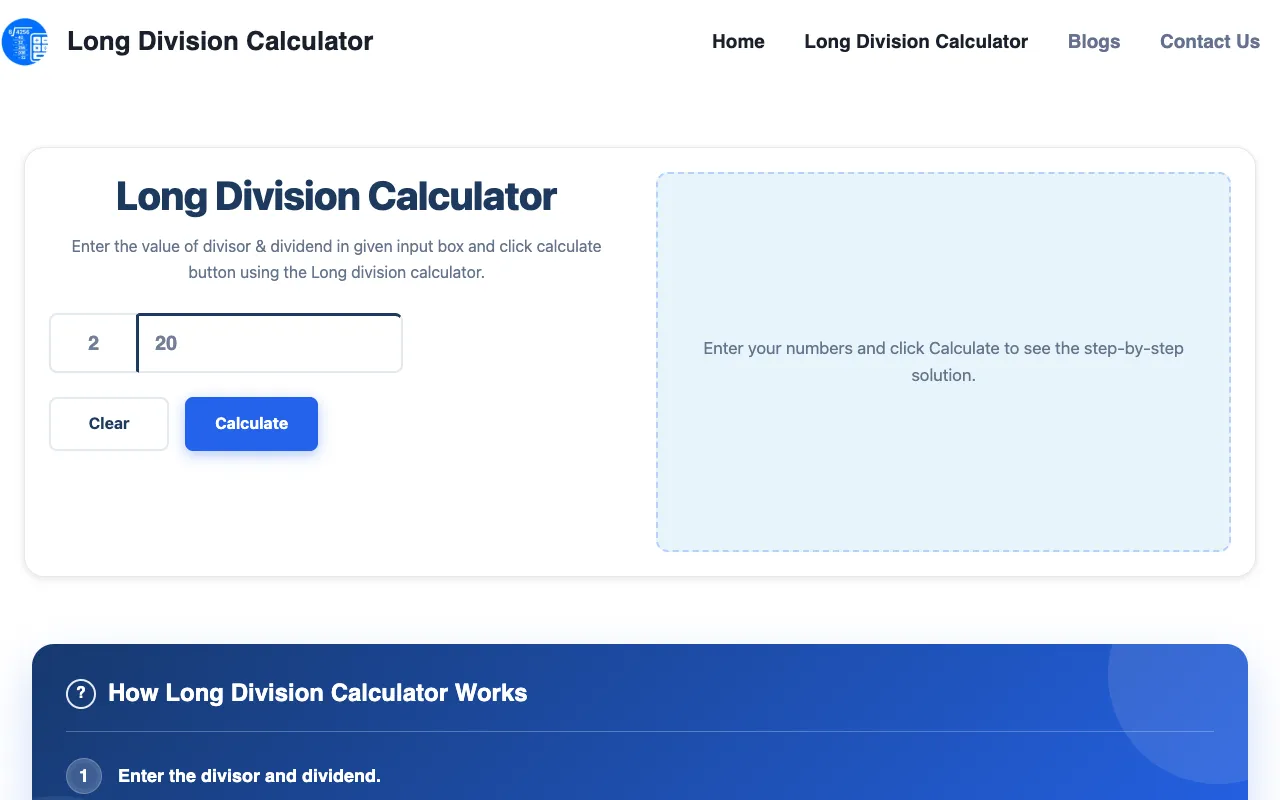
A free online long division calculator designed to help students learn and solve division problems step by step. The tool breaks down division problems into manageable steps, making it easier for learners to understand the mechanics of the long division process. It handles both basic division and problems with remainders, showing the complete working for each step to help students verify their manual calculations. The calculator serves as a learning resource for elementary and middle school students who are mastering division concepts. By providing detailed step-by-step solutions, it reinforces mathematical understanding rather than simply providing answers. The tool is straightforward and accessible for classroom use, self-study, and homework help, making long division less intimidating for learners.
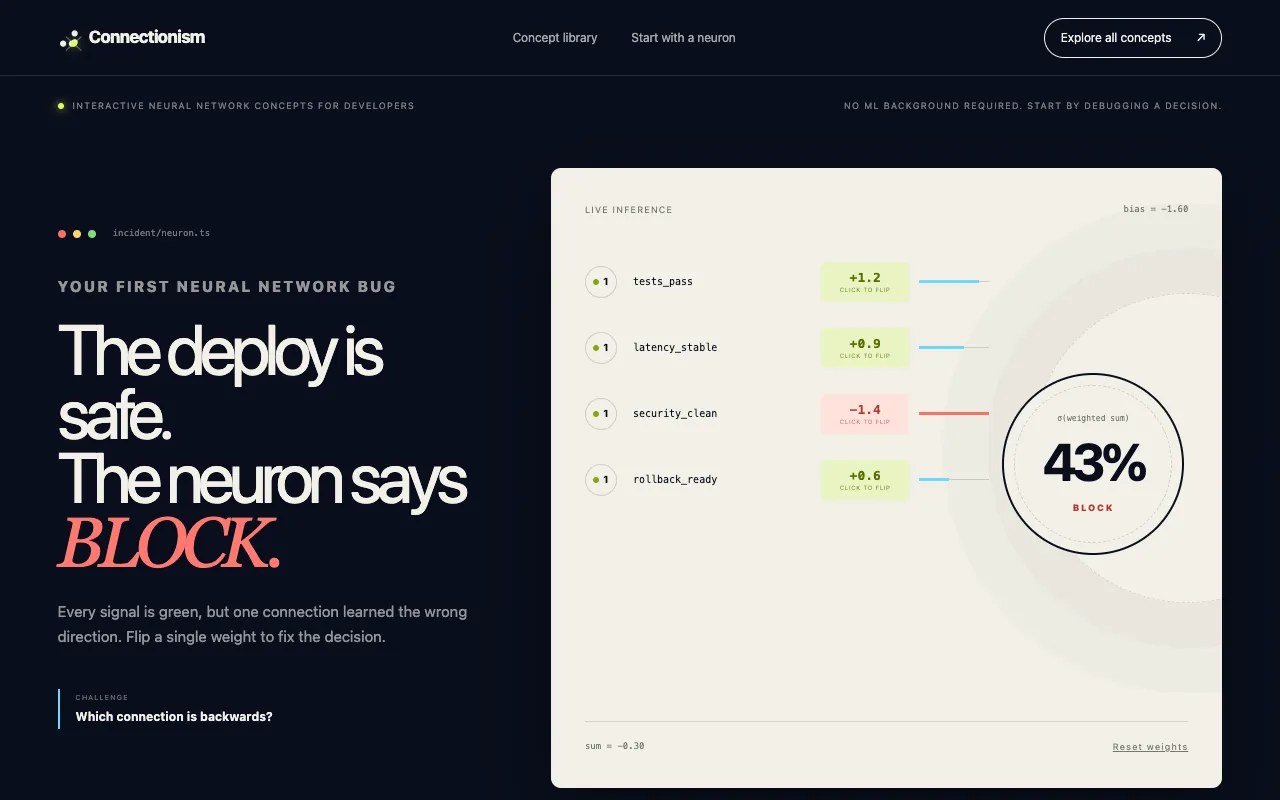
Connectionism offers free, interactive labs designed to help developers understand neural networks through hands-on experimentation. The platform provides visual, puzzle-based learning experiences that require no login or setup. Each lab focuses on a specific concept, making it easy to learn at your own pace without barriers. The labs cover essential deep learning concepts including neurons, activation functions, gradient descent, overfitting, embeddings, and attention mechanisms. Rather than passive reading, each topic combines theory with interactive exploration, allowing you to visualize how neural networks learn and adjust their parameters in real time. This hands-on approach helps developers build practical intuition about how deep learning systems work and make decisions.