01

01
Omni Calculator
omnicalculator.com
Our hydrostatic pressure calculator is here to help you if you want to find the hydrostatic pressure at a certain depth.
Calculates hydrostatic pressure based on depth, density of fluid, and gravitational acceleration. User inputs these parameters to determine the pressure at a given point in a liquid or other homogeneous fluid column. Engineers, scientists, students, and anyone working with fluids in various fields such as civil engineering, oceanography, meteorology, and more can use this calculator to understand...
Our hydrostatic pressure calculator is here to help you if you want to find the hydrostatic pressure at a certain depth.
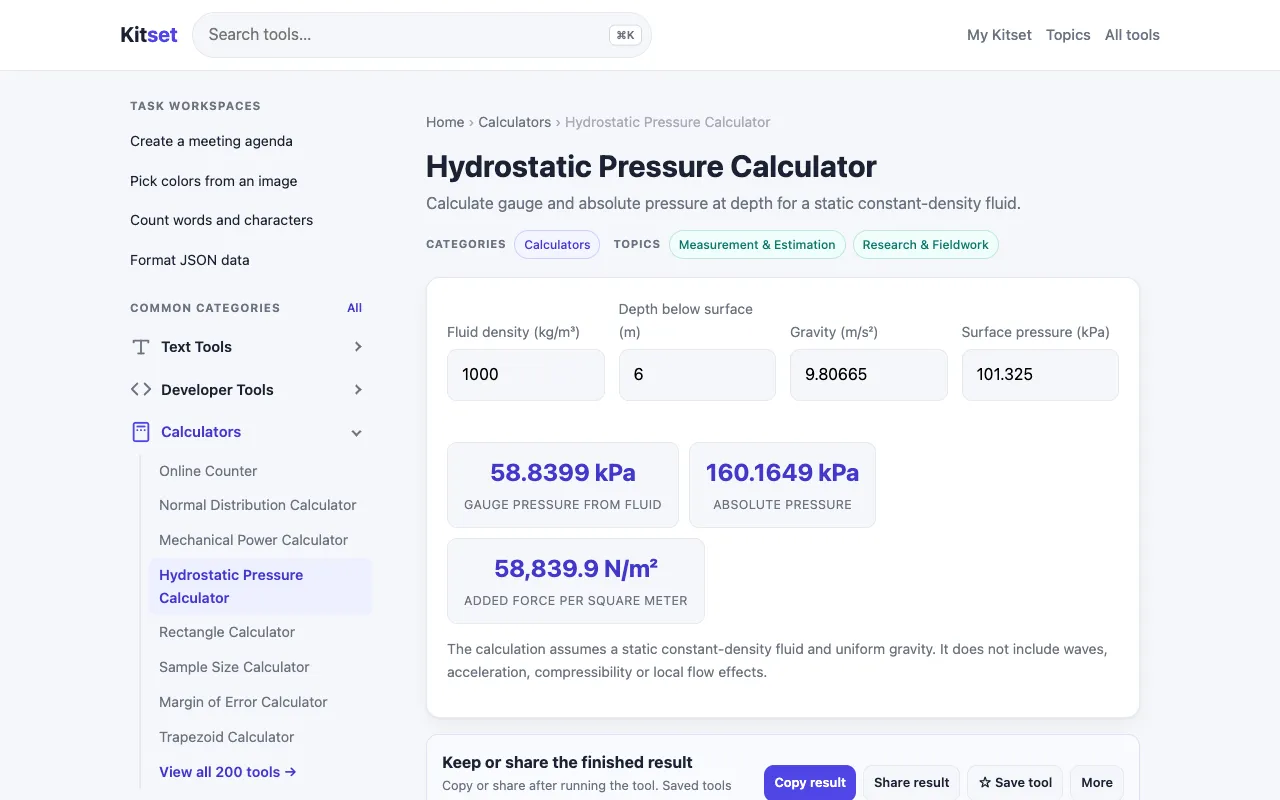
Calculate hydrostatic gauge pressure, absolute pressure and force per square meter from fluid density, depth, gravity...
Side by side
| Tool | Best for | Strengths | Limitations |
|---|---|---|---|
| Omni Calculator omnicalculator.com | Quick hydrostatic pressure estimates |
|
|
| Kitset kitset.app | Absolute pressure and force per area calculations |
|
|
Buyer's guide
If you need the pressure at a specific depth in a common fluid like water or oil, Omni Calculator’s preset fluid list saves time and reduces entry errors. If your work involves absolute pressure (including atmospheric or surface pressure) or you need the total force on a specific area, Kitset provides those extra outputs but requires you to input all densities and pressures manually.
Questions