Biology3 options compared

Mulch Calculator

Estimates total mulch needed for an area, considering dimensions and coverage. Helps users determine associated costs based on material prices. Gardeners, landscapers, and anyone planning to cover soil with mulch find this tool invaluable for planning and budgeting purposes. It simplifies the complex calculations involved in mulching large or irregularly shaped areas, providing accurate estimates...

Editors’ Top PickBased on community votes
Other OptionsRanked by votes
  1. Screenshot of Calculator.net
    02
    Calculator.net
    calculator.net

    This free mulch calculator estimates the total amount of mulch needed to cover an area, such as a garden. It can also...
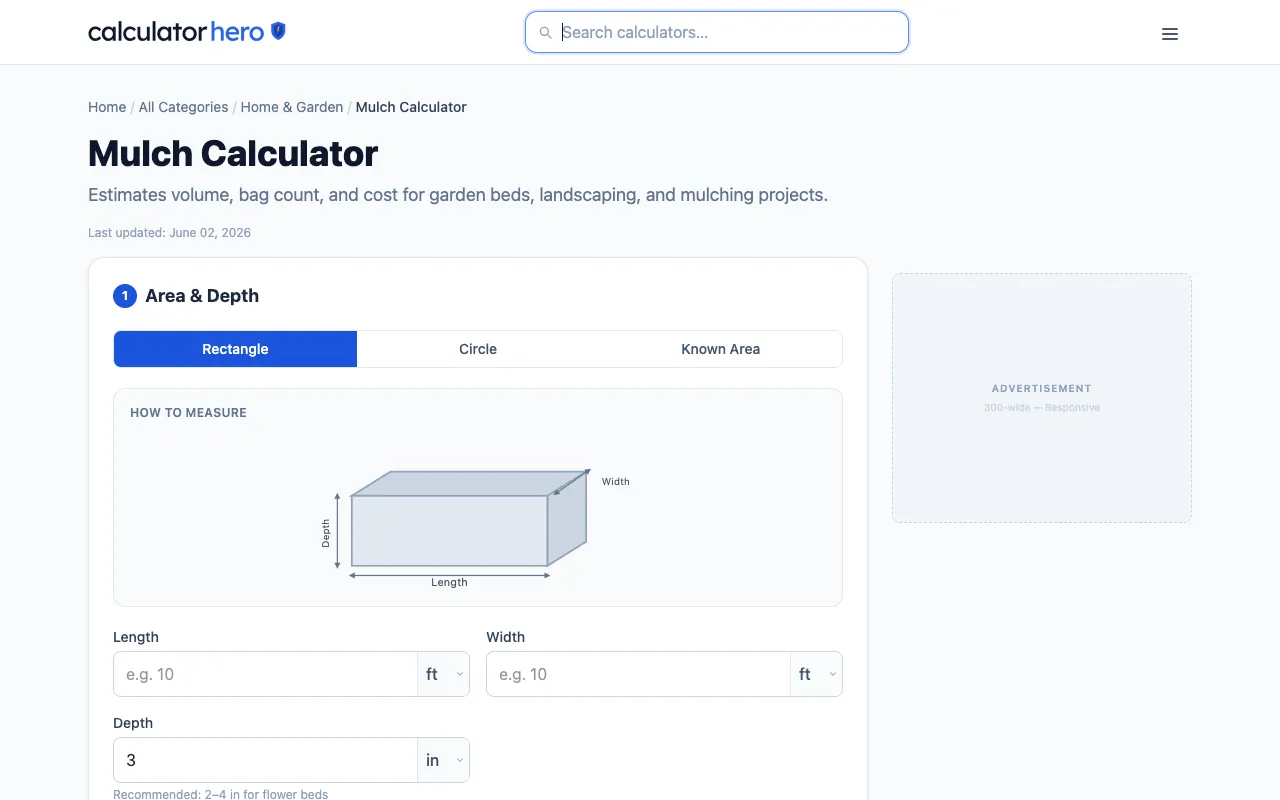
  2. Screenshot of Calculator Hero
    03
    Calculator Hero
    calculatorhero.net

    Calculates mulch material requirements for garden beds and landscaping projects using project dimensions. Provides re...

Side by side

Mulch Calculator options compared

ToolBest forStrengthsLimitations
Omni Calculator
omnicalculator.com
Quick mulch estimates
  • Simple input fields for area, depth, and price
  • Outputs volume, bag count, and total cost in one result
  • No support for irregular shapes or multiple zones
  • Fewer price-per-unit options than some competitors
Calculator.net
calculator.net
Large or split projects
  • Supports adding many separate areas
  • Wide range of price units (cubic foot, yard, meter, liter, bag sizes)
  • Can estimate cost if price per unit is provided
  • Very dense form with many fields to fill
  • Interface feels dated and may overwhelm casual users
Calculator Hero
calculatorhero.net
Garden beds with specific mulch types
  • Built-in recommended depth guides for flower beds, trees, vegetable gardens
  • Outputs cubic yards, bag quantities, and cost for common mulch types like wood chips and bark mulch
  • Cleaner layout than Calculator.net; supports price per bag or per cubic yard
  • No explicit community votes recorded
  • Fewer price-per-unit options than Calculator.net; bag-size choices are limited to common sizes (2 ft³, 3 ft³, 57 L, 85 L)

Buyer's guide

How to choose a mulch calculator

When picking a mulch calculator, first measure the area you plan to cover — length times width in feet, or use the tool’s built-in area field if you already know the total square footage. Decide on the mulch depth you want; most garden beds need 2–4 inches, while playgrounds or heavy weed suppression may need 6–9 inches. Then enter your price per unit (per bag, per cubic yard, etc.) so the tool can calculate total cost. If your project is a single, simple rectangle, a tool that asks for area and depth will be fastest. If you have multiple zones, different depths, or want to compare bag sizes and prices across types, look for a calculator that lets you add several areas and choose from many price-per-unit options.

Questions

Mulch Calculator FAQ

How do I calculate mulch needed for an irregularly shaped garden?
Break the shape into rectangles or triangles, calculate the area of each section, then add them together. Some mulch calculators let you add multiple areas separately, which is easier than doing the math by hand.
How deep should mulch be for flower beds?
A depth of 2–3 inches is typically recommended for flower beds. This depth suppresses weeds while allowing water and air to reach plant roots.
Can I calculate mulch cost if I only know the price per bag?
Yes. Enter the price per bag and the bag size (e.g., 2 ft³ or 57 L), and the calculator will determine the number of bags needed and the total cost for your project.
What is the difference between cubic yards and cubic feet of mulch?
One cubic yard equals 27 cubic feet. Mulch is often sold by the cubic yard for bulk delivery or by the cubic foot for bagged bags, so check which unit the seller uses before buying.
Do I need to convert inches to feet before using a mulch calculator?
Most calculators handle the conversion for you; you can enter depth in inches and the tool will convert it to feet internally. If you are calculating by hand, divide inches by 12 to get feet.
Keep Exploring

Related tools in Biology

View all →