178 tools
Generates the Sierpinski arrowhead curve fractal by iteratively applying a set of geometric rules to an initial triangle. Users input parameters such as iteration count and can visualize the evolving pattern in real-time on the tool's interface. Math enthusiasts, educators, and students exploring fractals and geometric mathematics will find this tool invaluable for creating educational materials, conducting research, or simply generating visually stunning patterns for artistic purposes.
Generates the Sierpinski carpet fractal. This tool visually represents a mathematical pattern by recursively removing squares from a larger square, leaving an intricate design of smaller squares arranged in a checkerboard-like fashion. Artists, mathematicians, and educators might use this tool to demonstrate fractal geometry, explore self-similarity, or simply create aesthetically pleasing designs.
Generates the Sierpinski pentaflake fractal. This tool allows users to input parameters such as size, color, and iterations to create intricate geometric patterns based on the mathematical principles of the Sierpinski pentagon. It is ideal for mathematicians, educators, artists, and anyone interested in exploring the beauty and complexity of fractal geometry. Math enthusiasts and students can use it to visualize and study properties of fractals, while teachers can incorporate it into lessons to teach geometric concepts and patterns. Artists and designers might find it useful for generating unique textures or patterns for their work.
Generates the Sierpinski hexaflake fractal, a mathematical pattern resembling a never-ending tessellation of hexagons. By recursively removing triangles from a central equilateral triangle, this tool creates intricate designs that demonstrate fractal geometry's self-similarity at various scales. Math enthusiasts, educators, and anyone interested in geometric patterns will find value in this tool for visualizing complex mathematical concepts. Students can use it to explore the properties of fractals and their real-world applications. Artists may incorporate these mesmerizing hexagonal patterns into their work for a unique aesthetic touch.
Generates the Koch snowflake fractal using an iterative process. The algorithm starts with an equilateral triangle and adds smaller triangles to each side, repeating this pattern infinitely to create a complex, self-similar geometric shape. Users can explore mathematical concepts related to fractals, visualize fractal geometry, or simply generate visually appealing patterns for artistic or educational purposes. Math enthusiasts, educators, students, and anyone interested in fractals will find the Koch snowflake generator useful for learning about recursive processes, symmetry, and infinite detail. The tool provides a hands-on way to understand how simple geometric rules can lead to complex outcomes, making it an engaging resource for both casual users and professionals alike.
Generates the classic Cantor set fractal through iterative removal of middle third segments from an initial line segment, creating self-similar patterns at every scale. Ideal for mathematicians, students, and anyone interested in exploring mathematical concepts visually. Educational institutions, researchers, and enthusiasts can use this tool to study fractals, chaos theory, and the properties of infinite sets. It provides a visual representation that aids in understanding complex mathematical ideas through simple iteration.
Generates the Pythagoras tree fractal, a mathematical pattern using squares and right triangles. Users input parameters like starting size and iterations to create unique visual representations of this geometric shape. Ideal for mathematicians, students, and anyone interested in exploring fractals and geometric patterns. It helps users visualize complex mathematical concepts through interactive and visually appealing graphics.
Generates the H-tree structural fractal by recursively branching out in an "H" shape, creating intricate patterns from simple lines. Ideal for mathematicians, artists, and anyone interested in exploring complex geometric structures. Ideal for designers looking to create unique visual elements, educators teaching mathematical concepts like recursion and fractals, and researchers studying pattern formation in nature and technology.
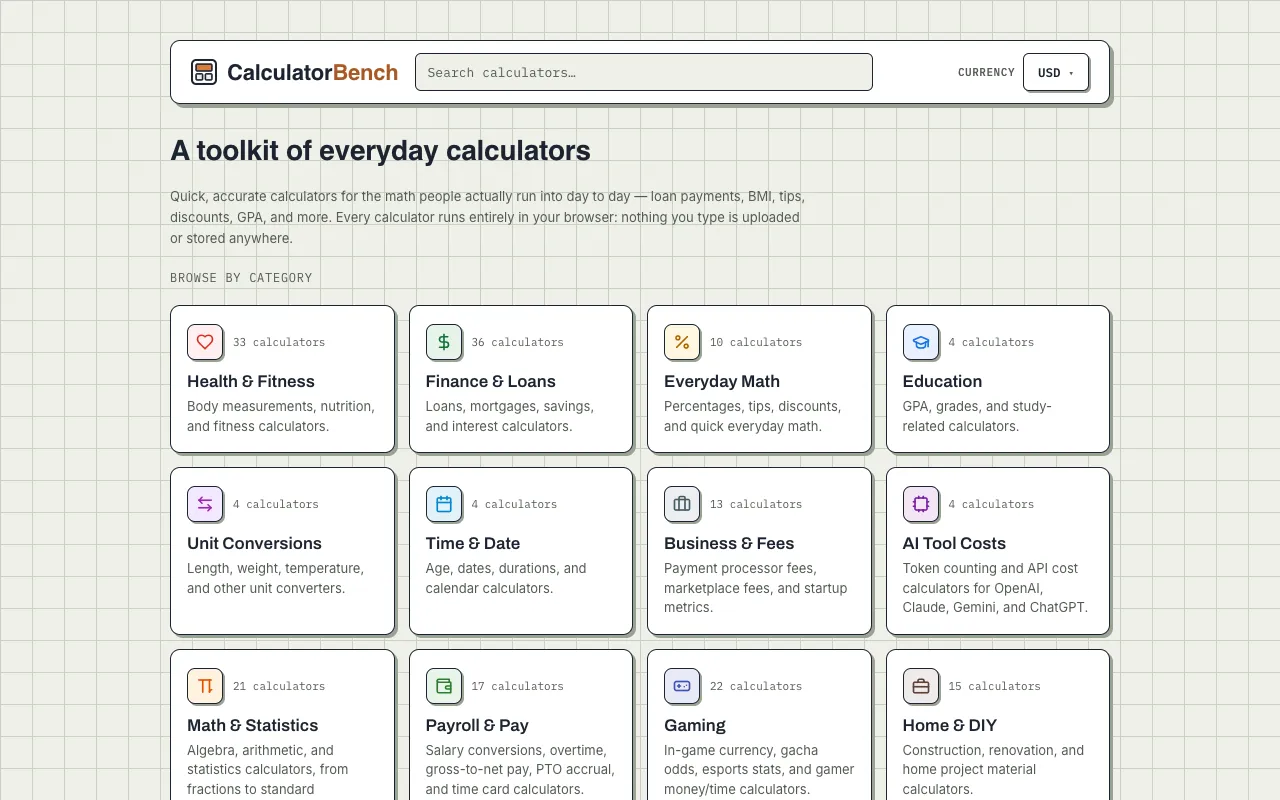
Calculator Bench provides a comprehensive collection of free online calculators designed for everyday mathematics and financial planning. The diverse suite includes specialized tools for body mass index (BMI) calculations, loan amortization schedules, compound interest projections, percentage calculations, tip splitting and calculations, discount computations, age calculations, grade point average (GPA) tracking, and extensive unit conversions spanning distance, weight, temperature, volume, and other common measurement systems. All calculations run securely and instantly in your web browser with zero registration or sign-up required. Your numbers remain completely private on your device and are never uploaded to any external server, ensuring full data privacy and complete peace of mind when performing sensitive financial or personal calculations.
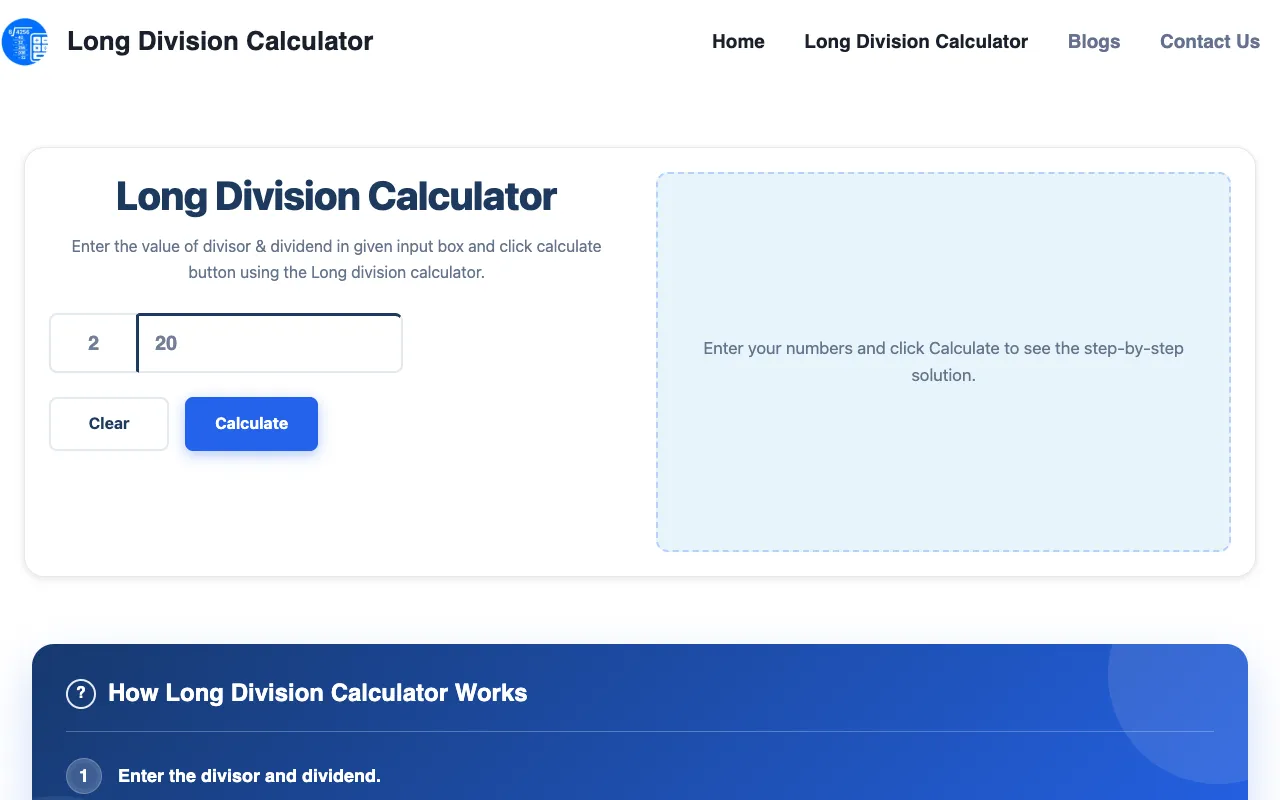
A free online long division calculator designed to help students learn and solve division problems step by step. The tool breaks down division problems into manageable steps, making it easier for learners to understand the mechanics of the long division process. It handles both basic division and problems with remainders, showing the complete working for each step to help students verify their manual calculations. The calculator serves as a learning resource for elementary and middle school students who are mastering division concepts. By providing detailed step-by-step solutions, it reinforces mathematical understanding rather than simply providing answers. The tool is straightforward and accessible for classroom use, self-study, and homework help, making long division less intimidating for learners.