01

01
Omni Calculator
omnicalculator.com
Use this law of cosines calculator to determine the third side of a triangle knowing two sides and the angle between ...
Calculates unknown sides and angles within a non-right triangle using the Law of Cosines formula. Users input specific measurements to determine missing values, offering two primary functions. The first function allows users to find the length of the third side when given two known sides and the included angle (SAS). Alternatively, it can calculate the internal angles of a triangle when all three...
Use this law of cosines calculator to determine the third side of a triangle knowing two sides and the angle between ...

Solves triangle problems using the law of cosines when two sides and an included angle are known.
Side by side
| Tool | Best for | Strengths | Limitations |
|---|---|---|---|
| Omni Calculator omnicalculator.com | Students needing formula context |
|
|
| Pi Day Calculators piday.org | Engineers needing precise unit options |
|
|
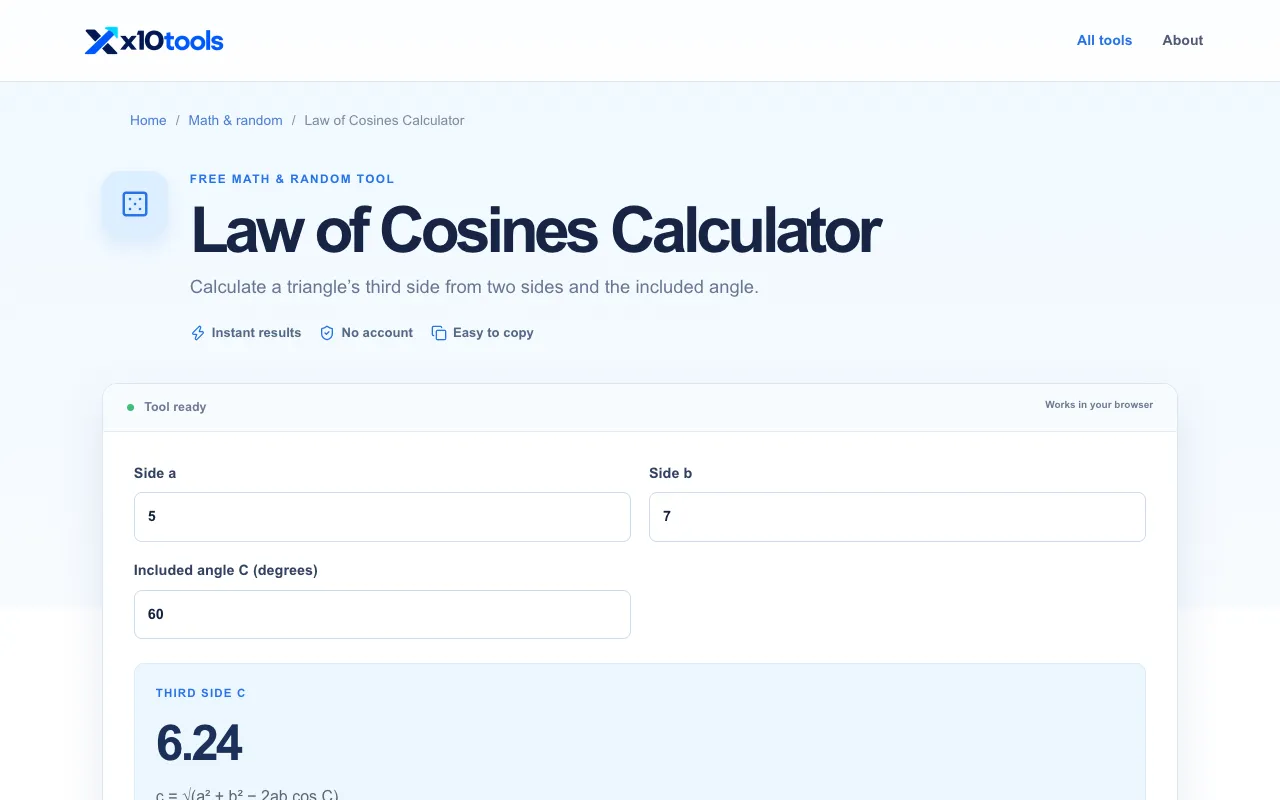
| X10Tools x10tools.com | Quick one-off calculations without account |
|
|
Buyer's guide
When picking a law of cosines calculator, first decide whether you need to find a missing side (SAS) or missing angles (SSS) — most tools handle both but some emphasize one function. Check the unit support if your measurements use non-standard units like yards or milliradians, and look for community votes or user reviews to assess reliability for important work.
Questions