Height and Weight Calculator
The Army Height and Weight Calculator is a free online tool that helps U.S. Army personnel and recruits quickly deter...
What Height and Weight Calculator does
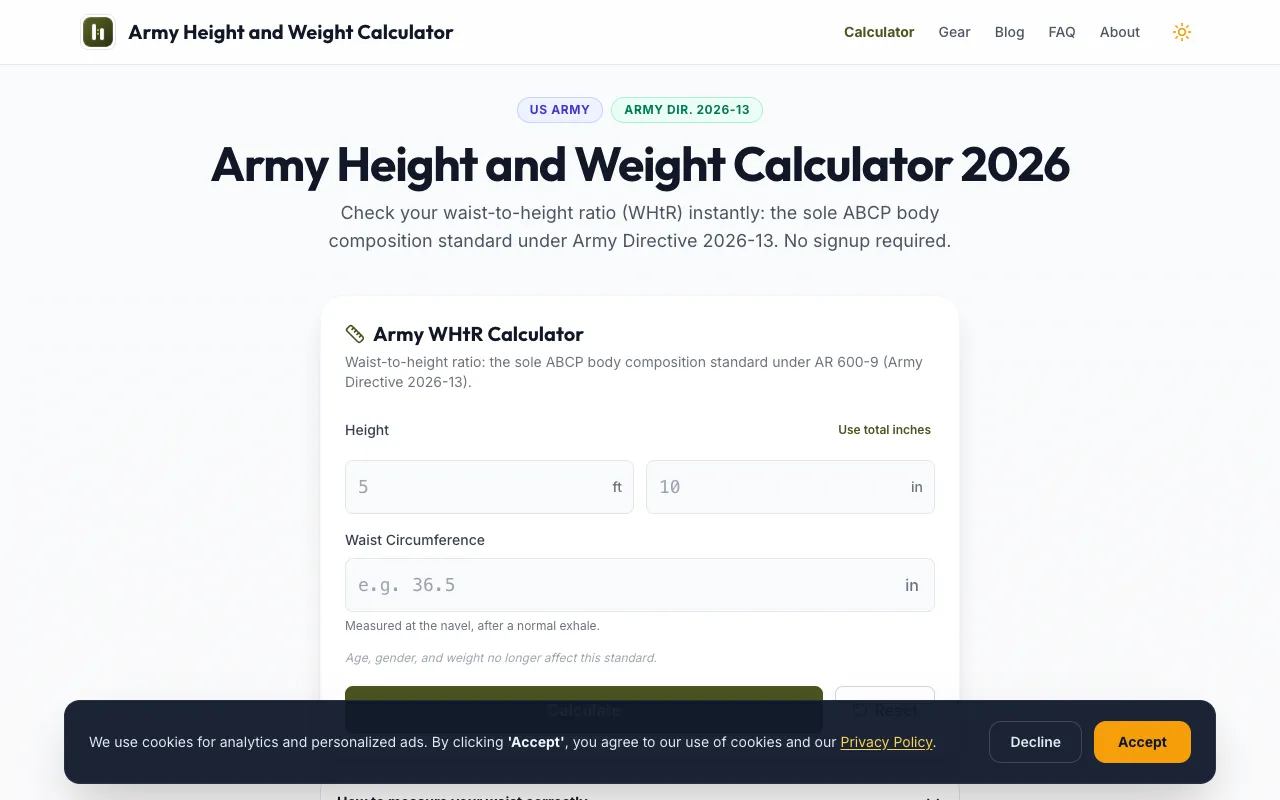
The Army Height and Weight Calculator is a free online tool that helps U.S. Army personnel and recruits quickly determine if their measurements meet official body composition standards as outlined in Army Regulation 600-9. Simply enter your gender, height, and weight to instantly receive your BMI calculation and confirmation of whether you fall within the Army's allowable weight limits for your height category. The site provides immediate clarity on compliance with Army standards, designed specifically for recruits preparing for enlistment and soldiers preparing for periodic fitness evaluations. The 2026 version of the calculator has expanded to include waist-to-height ratio (WHtR) as the primary body composition standard under Army Directive 2026-13, replacing BMI as the sole assessment method and offering separate thresholds for different Army components. It also provides guidance on how to measure waist correctly and target waist circumferences based on individual height. The interface features clear input fields for height in feet and inches, waist circumference at the navel, and a prominent calculate button, with results displayed alongside explanatory notes about measurement technique and compliance margins.
How to use the Army Height and Weight Calculator Height and Weight Calculator
- 1
Select your gender from the dropdown menu
- 2
Enter your height in feet and inches using the provided fields
- 3
Input your waist circumference measured at the navel after a normal exhale
- 4
Click the Calculate button to receive your WHtR result and compliance status against Army standards
Best for
Best for U.S. Army personnel, recruits, and candidates who need to verify compliance with official body composition standards before enlistment or periodic fitness evaluations, particularly those preparing for MEPS or annual assessments.
Limitations
- Designed specifically for Army standards and may not apply to other military branches or civilian fitness assessments
- Waist circumference measurement requires proper technique at the navel for accurate results
- Results are estimates based on Army regulatory thresholds and do not substitute professional medical evaluation
Height and Weight Calculator FAQ
- Can I use this calculator if I'm not joining the Army?
- The Army Height and Weight Calculator is designed specifically for U.S. Army personnel and recruits following Army Regulation 600-9. While waist-to-height ratio is now a Pentagon-wide standard, each service branch has different thresholds (Air Force and Space Force use 0.550, Marine Corps uses 0.520), so this tool's results would not apply to non-Army service members.
- How should I measure my waist for the most accurate result?
- Measure at the navel after a normal exhale, using a non-stretch body tape measure with tenth-of-an-inch markings. The site emphasizes that cheap fabric tapes stretch with use, and at the 0.550 boundary, half an inch can change your result, so using a proper measuring tape is important for accuracy.
- What happens if my WHtR is close to the 0.550 threshold?
- The calculator provides your exact target waist circumference and shows how much margin you have above or below the 0.550 boundary, giving you a clear planning number rather than just a pass/fail determination. This helps you understand how much you need to adjust your waist measurement to meet the standard.
- Does age or weight affect the WHtR calculation?
- According to Army Directive 2026-13, age, gender, and weight no longer affect the WHtR standard. The waist-to-height ratio is the sole body composition standard under AR 600-9, making it different from the previous BMI-based approach that considered these factors.
Similar tools
Based on shared tags